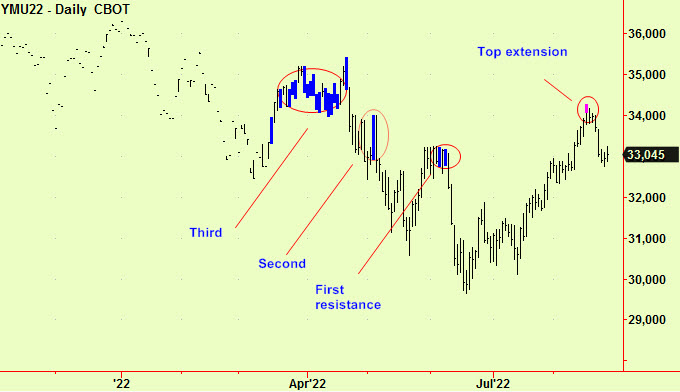
As the stock market rally took hold through July, we pointed out resistance from old compressions in the Dow that would likely bring the up-move to an end. There are several of these, quite closely spaced and the market pushed through the first one, then stalled at another. Like the Soviet ‘defence in depth’ that blunted the Wehrmacht assault at the battle of Kursk these successive layers of resistance were always going to be tough to surmount and this failure looks like a crucial defeat for bulls. We have been expecting this rally to stall and ultimately fail, so this is an important juncture. The market also made a top extension, which usually marks the end of an ‘up-leg’, as it did here:
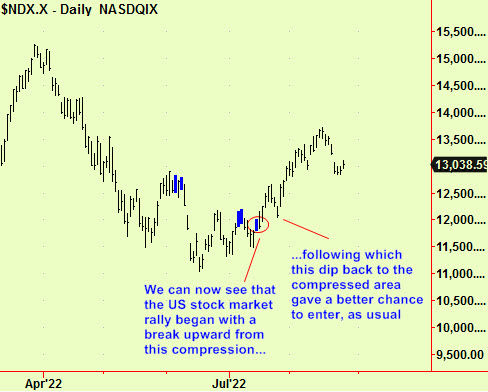
This rally started with a compression that broke upwards, not in the Dow but in a Nasdaq index (see below). The most useful aspect of compressions that come at the beginning of a new move is that they act as ‘strange attractors’ by alternately repelling the price (into a new trend) and then ‘attracting it back’ to re-visit the compressed area before lastly repelling it again to resume the trend. Such behaviour is quite normal in complex systems ruled by feedback loops, of which markets are a prime example, and there is more on this in our user guides.
We rarely recommend taking a trade at the moment of the compression break as it is often unclear whether or not a break has occurred – the price may move away only tentatively, or sometimes move so far so and fast that we are reluctant to follow. This customary ‘return movement’ to the compressed area is a much better chance to enter a trade, early into a trend we can already see. This was a typical case:
All signals from software supplied by our friends at Parallax Financial www.pfr.com